

Regulatory Terminology Management: Intelligence Matters
Cosmetic regulatory intelligence starts with terminology.
What if one PIF section lists “Water” instead of “Aqua,” but other sections use “Aqua”?CPNP detects mismatches, delaying or rejecting submissions.
What if a claim says “reduces wrinkles” but evidence only supports “visibly reduces wrinkle appearance”?
The submission may prompt regulatory questions. Terminology accuracy is binary: either ingredient names, regulatory classifications, and claim language match requirements exactly, or the submission fails.
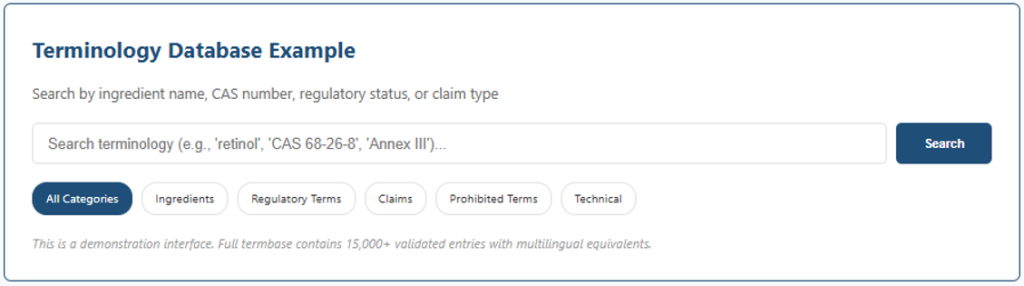
Core Terminology Categories for Regulatory Compliance
Regulatory termbases for dermocosmetics localization must include compliance metadata, usage restrictions, and market variations beyond simple translations.
1. Ingredient Nomenclature (INCI System)
The International Nomenclature of Cosmetic Ingredients (INCI) provides standardized naming that must remain consistent across all documentation. Terminology systems must link INCI names to CAS numbers, EC numbers, and common chemical names while flagging regulatory status.
| INCI Name | CAS Number | EC Number | Regulatory Status | Market Variants |
|---|---|---|---|---|
Retinol |
68-26-8 | 200-683-7 | ANNEX III Max 0.3% (rinse-off), 0.05% (leave-on) |
EU: Retinol FDA: Retinol (Vitamin A) China IECIC: 视黄醇 |
Aqua |
7732-18-5 | 231-791-2 | UNRESTRICTED |
EU: Aqua US: Water Japan: 水 China: 水 |
Titanium Dioxide |
13463-67-7 | 236-675-5 |
ANNEX VI
UV Filter, Max 25% EU BAN Powder/spray (inhalation risk) |
EU: Titanium Dioxide / CI 77891 FDA: Titanium Dioxide China: 二氧化钛 |
Sodium Lauryl Sulfate |
151-21-3 | 205-788-1 | UNRESTRICTED Note: Frequent allergen disclosure |
EU: Sodium Lauryl Sulfate Also: SLS China: 十二烷基硫酸钠 |
Tocopherol |
59-02-9 | 200-412-2 | UNRESTRICTED |
EU: Tocopherol FDA: Tocopherol (Vitamin E) Common: Vitamin E China: 生育酚 |
Critical: INCI Name Consistency
Never use chemical names, trade names, or colloquial equivalents in regulatory submissions. “Vitamin E” in a PIF where the ingredient list shows “Tocopherol” creates automatic compliance failures. Terminology systems must enforce INCI nomenclature consistently across all document types.
2. Regulatory Classification Terms
EU Regulation 1223/2009 establishes specific classifications that require precise terminology. Mistranslating or misapplying these terms creates immediate compliance issues.
| Term (EN) | Category | Definition/Context | Common Errors |
|---|---|---|---|
|
Cosmetic Product
|
DEFINITION | Any substance/mixture intended to be placed in contact with external parts of human body (epidermis, hair, nails, lips, external genitalia) or teeth and mucous membranes with exclusive/main view to cleaning, perfuming, changing appearance, protecting, keeping in good condition, or correcting body odors |
✕ Translated as “beauty product” loses regulatory specificity ✕ “Cosmetic item” incorrect legal terminology |
|
Responsible Person
|
LEGAL ENTITY | Natural/legal person responsible for compliance of cosmetic product with Regulation 1223/2009. Must be established in EU. |
✕ “Accountable party” not recognized term ✕ “Manufacturer” different legal role |
|
Product Information File (PIF)
|
DOSSIER | Complete documentation for cosmetic product per Article 11, including formulation, safety assessment, manufacturing method, efficacy proof, animal testing statement |
✕ “Product dossier” too generic ✕ Acronym only without full term first use |
|
Safety Assessment
|
REQUIRED DOC | Assessment of safety for human health of finished cosmetic product. Must be carried out by person with diploma/certificate in pharmacy, toxicology, medicine, or similar |
✕ “Safety evaluation” not exact term ✕ “Safety report” different document |
|
Undesirable Effects
|
REPORTING | Adverse reaction directly or indirectly related to use of cosmetic product under normal or reasonably foreseeable conditions of use |
✕ “Side effects” medicinal terminology ✕ “Negative reactions” too informal |
3. Claim Substantiation Terminology
Product claims must align precisely with substantiation evidence tiers. Terminology systems must categorize claims by regulatory risk and evidence requirements.
| Claim Type | Evidence Required | Approved Language | Prohibited Variants |
|---|---|---|---|
|
Physiological Effect
|
CLINICAL In vivo human studies, statistical significance p<0.05 |
✓ “Clinically proven to reduce wrinkle depth by X%” ✓ “Increases skin hydration by X% in Y weeks” |
✕ “Eliminates wrinkles” ✕ “Reverses aging” ✕ “Heals skin damage” |
|
Optical Effect
|
CONSUMER Consumer perception studies, instrumental measurements |
✓ “Visibly reduces appearance of wrinkles” ✓ “Skin appears brighter immediately” |
✕ “Reduces wrinkles” (without “appearance of”) ✕ “Lightens skin” (without “appearance”) |
|
Sensorial Effect
|
CONSUMER Consumer testing, self-assessment questionnaires |
✓ “Skin feels smoother” ✓ “Leaves skin feeling soft” |
✕ “Makes skin smoother” (implies change) ✕ “Transforms skin texture” |
|
Moisturization
|
IN VIVO Corneometry, TEWL measurements, or clinical assessment |
✓ “Hydrates skin for 24 hours” ✓ “Moisturizes and nourishes skin” |
✕ “Repairs skin barrier” (medicinal) ✕ “Cures dry skin” |
Prohibited: Medicinal/Therapeutic Claims
Never use in cosmetics documentation: treat, cure, prevent, heal, restore, repair (biological function), regenerate, therapy, therapeutic, medicine, drug, disease, disorder, condition, syndrome, remedy, prescription, clinical treatment.
These terms trigger drug classification requiring pharmaceutical regulatory pathways.
4. Technical and Process Terminology
| Term | Context | Precise Definition |
|---|---|---|
|
Good Manufacturing Practice (GMP)
|
QUALITY | Quality assurance system ensuring products are consistently produced and controlled according to quality standards appropriate to their intended use and as required by marketing authorization |
|
Batch/Lot Number
|
TRACEABILITY | Unique identification enabling traceability of manufacture and distribution. Must appear on cosmetic product labeling per Article 19(1)(g) |
|
Period After Opening (PAO)
|
LABELING | Period during which product remains safe and can be used without harm to consumer after opening. Indicated by open jar symbol with number of months |
|
Minimum Durability Date
|
LABELING | Date until which cosmetic product continues to fulfill its initial function and remains safe. Indicated as “Best before end of” or hourglass symbol |
Building Regulatory Termbase Architecture
Traditional glossaries fail for regulatory localization because they treat terms as isolated translation pairs. Effective regulatory termbases model relationships between ingredients, classifications, restrictions, and market requirements — and are the backbone of scalable cosmetic regulatory intelligence.
Essential Termbase Fields
Core Identification
- Source term (EN master)
- Target equivalents (all languages)
- Part of speech
- Domain category
- Synonyms and variants
Regulatory Metadata
- INCI nomenclature (if ingredient)
- CAS/EC numbers
- Annex classification
- Concentration restrictions
- Usage conditions
- Prohibited contexts
Market Variations
- EU approved term
- FDA equivalent (if different)
- China NMPA nomenclature
- Japan MHLW variant
- Other regional differences
Usage Controls
- Approved document types
- Mandatory vs. optional
- Context dependencies
- Do not use flags
- Quality assurance rules
Knowledge Graph Architecture for Terminology
Knowledge graphs represent the next evolution in regulatory terminology management, modeling complex relationships between ingredients, regulatory classifications, market requirements, and claim substantiation hierarchies.
What is a Knowledge Graph for Terminology?
Unlike flat databases with rows and columns, knowledge graphs store terminology as interconnected nodes and relationships. An ingredient node links to its CAS ID, compliance status, concentration limits, permitted markets, claim constraints, and banned pairings (searchable together within one integrated system).
Knowledge Graph Advantages
Relationship Preservation
- Ingredient → Annex classification
- Claim → Required substantiation
- Restriction → Product category
- Term → Market-specific variant
Automated Validation
- Flag Annex violations instantly
- Detect claim over-reach
- Verify concentration compliance
- Check prohibited combinations
Context-Aware Translation
- Different terms per document type
- Market-specific nomenclature
- Product category dependencies
- Regulatory framework alignment
Scalability
- Add new markets without restructuring
- Update regulations system-wide
- Integrate new ingredient approvals
- Expand claim hierarchies
Market-Specific Terminology Variations
Accessing accurate cosmetic regulatory information across jurisdictions is one of the most demanding aspects of international localization. Regulatory terminology varies significantly across major markets, and terminology systems must account for these differences to ensure compliance in each jurisdiction.
EU vs. FDA vs. China NMPA Terminology Comparison
| Concept | EU (EC 1223/2009) | FDA (USA) | China NMPA |
|---|---|---|---|
|
Water
|
Aqua (mandatory INCI) | Water (common name accepted) | 水 (Chinese character) |
|
Product Category
|
Cosmetic Product | Cosmetic vs. Drug (different thresholds) | General Cosmetics vs. Special Cosmetics |
|
Colorants
|
CI Number (Colour Index) Example: CI 77891 |
FD&C, D&C, Ext. D&C Example: FD&C Yellow No. 5 |
Chinese nomenclature + CI reference |
|
Safety Documentation
|
Product Information File (PIF) | Not required (voluntary registration) | Product Safety Assessment Report |
|
Responsible Entity
|
Responsible Person (must be EU-based) | Manufacturer/Distributor | Registrant (China-based entity required) |
|
Claims Regulation
|
Regulation 655/2013 (Claims Regulation) | Fair Packaging and Labeling Act | Cosmetic Labeling Management Measures |
|
Preservatives
|
Annex V (positive list) | Generally permitted unless prohibited | Positive list in IECIC |
Critical: Do Not Auto-Translate Regulatory Terms
Terms like “cosmetic product” have specific legal definitions that differ by jurisdiction. Direct translation without regulatory context creates compliance failures. Always use jurisdiction-specific approved terminology rather than literal translations.
Pre-Submission Terminology Validation Checklist
Complete before submission to a regulatory authority. Each item below represents a known failure point in cosmetic regulatory information management. At the same time, it is a checkpoint where submissions most commonly break down:
- All ingredient names match CosIng database exactly (EU) or appropriate national database
- INCI nomenclature is identical across PIF, CPNP, ingredient list, and label
- No chemical names, trade names, or common names used in place of INCI names
- Concentration values use correct decimal separators for target market (period vs comma)
- Measurement units are consistent (%, ppm, w/w) throughout documentation
- Annex classifications are accurately translated with market-specific terminology
- Claim language aligns with substantiation evidence tier
- No medicinal/therapeutic terms appear in cosmetics documentation
- Market-specific terminology variants applied correctly (EU vs FDA vs NMPA)
- Regulatory classifications use exact official terminology (not paraphrased)
- Cross-references between documents use identical terminology
- Prohibited terminology blacklist checked against all claim language
Regulatory Termbase for Your Product Portfolio
Our regulatory terminology specialists help you build comprehensive termbases with INCI nomenclature, Annex classifications, market-specific variants, and claim substantiation hierarchies—integrated directly into your localization workflows.
Ready to Expand Your Dermocosmetics Business Globally?
Partner with Intertranslations for regulatory-compliant, multilingual localization solutions backed by industry expertise and academic rigor.
ISO Certified Quality Standards
Our commitment to excellence is validated by international quality certifications.

ISO 17100:2015
Translation Services

ISO 9001:2015
Quality Management

ISO 27001:2013
Information Security